
The tool list
Buy less. Finish more.
A flooring aisle is designed to make you feel under-equipped. Most of it is for installers doing this every day. Here is the short list that earns its space in a normal garage, by floor type.
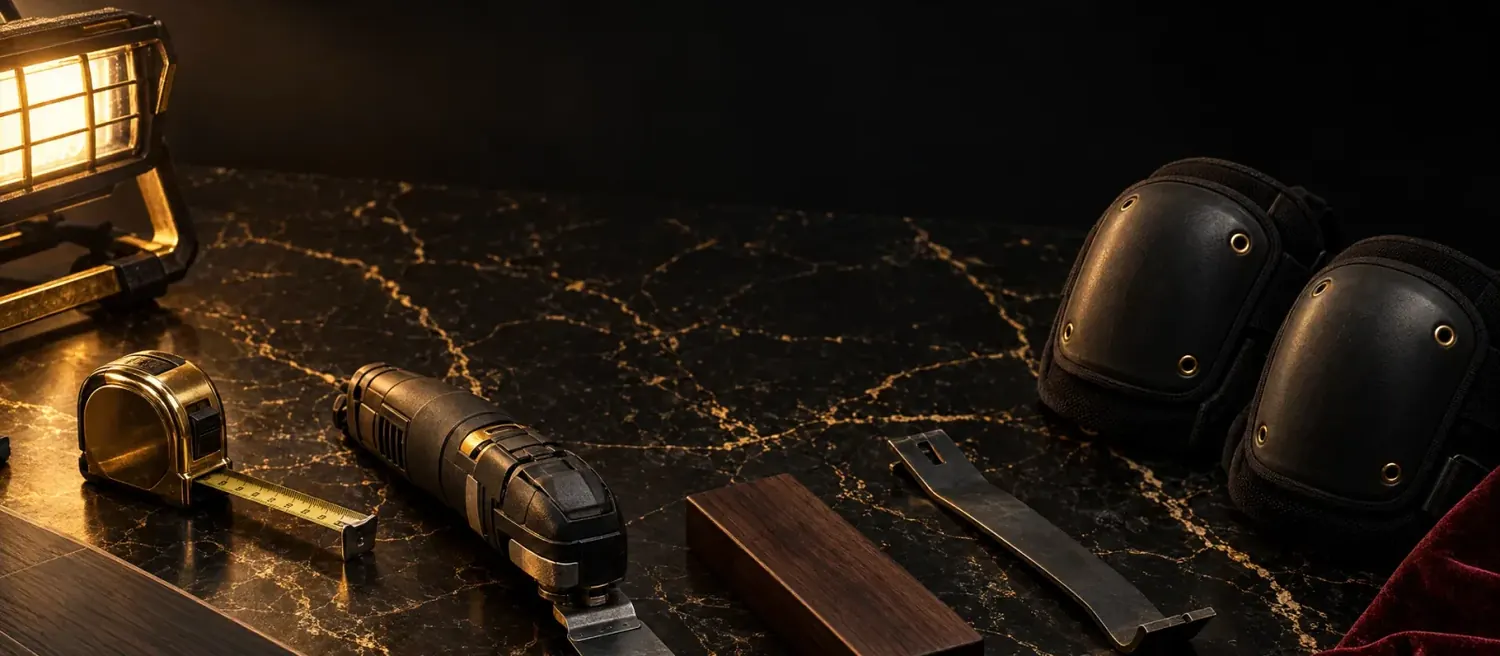
If a tool saves you one ruined plank, it has paid for itself. If it only saves you ten minutes on a job you will do once, borrow it or skip it. The exception is anything that protects the floor: knee pads, a tapping block and a proper straightedge are not luxuries.
The first five
These earn their keep in the first hour.
01
A 25 ft tape measure
Long enough for a normal room, stiff enough to measure alone. The case is part of the length; add it back when you measure into a corner.
02
An oscillating multi-tool
Undercut a jamb, cut a wall gap, trim a transition. Buy a mid-range one with a flush-cut blade; the cheapest models bog down in oak.
03
A tapping block and pull bar
The block spreads the hit so the click-lock survives. The pull bar closes the last row without a second person standing on the plank.
04
A flat pry bar
For trim, thresholds and the plank you regret. Wide, thin and stiff; a cheap bar bends exactly when you need leverage.
05
Knee pads
You will be on the floor longer than you think. The gel ones are worth it. This is the least glamorous advice on the site and the most reliable.
By floor type
The list changes with the floor.
Laminate and click-lock LVP
| Tool | Why you need it | Buy or borrow |
|---|---|---|
| Spacers | Hold the expansion gap at every wall while the planks go down. | Buy; they are cheap and you need dozens. |
| Tapping block | Seats a plank without crushing the locking edge. | Buy. |
| Pull bar | Closes the last row against a wall where you cannot swing a mallet. | Buy. |
| Oscillating multi-tool | Undercuts jambs and cuts the wall gap after the floor is down. | Buy mid-range. |
| Utility knife and straightedge | Clean cuts at doorways and around obstructions. | Buy. |
| Moisture meter | Tells you whether a slab or a suspicious seam is wet. | Borrow or buy a cheap pin meter. |
Glue-down engineered and solid hardwood
| Tool | Why you need it | Buy or borrow |
|---|---|---|
| Notched trowel | Spreads adhesive at the notch the adhesive maker specifies. | Buy the exact notch; do not guess. |
| Floor roller | Presses the planks into the adhesive evenly. | Borrow or rent; you use it once. |
| Mallet and tapping block | Closes joints without damaging the tongue. | Buy. |
| Nailer or stapler | For nail-down solid hardwood, not for floating floors. | Rent; do not buy for one room. |
| Pry bar and trim puller | Gets the baseboard off without taking the drywall with it. | Buy. |
Tile
| Tool | Why you need it | Buy or borrow |
|---|---|---|
| Notched trowel | The notch size controls the thinset bed; the bag specifies it. | Buy the size on the bag. |
| Leveling clips and wedges | Hold neighbouring tile edges level while the thinset sets. | Buy; they are consumable. |
| Wet saw | Straight, chip-free cuts in porcelain and stone. | Rent for a room; buy only if tiling becomes a habit. |
| Grout float, sponge and bucket | Packs grout and cleans the face without gouging it. | Buy. |
| Rubber mallet | Beds a tile without cracking it. | Buy. |
Save the money
Borrow these. Honestly.
Floor nailer
A good one costs more than the rental for a weekend, and you will use it for one room. Rent it, buy the fasteners, return it Monday.
Wet saw
Unless you are tiling a whole house, rent. A cheap saw with a bad blade chips porcelain and makes every cut look homemade.
Moisture meter
A pin meter is inexpensive, but if you only need one reading, borrow one. The number matters more than the brand.
Jamb saw
A dedicated undercut saw is faster than a multi-tool, but the multi-tool you already own will do four jambs.
The measuring section
The tape measure test.
Most "the planks don't fit" problems are measurement problems. Find your longest run, then pick the tape that reaches it without a helper holding the end.
Measure the widest point and the narrowest point of the room, not just the middle. Write both down. A floor that is 3/4 in out of square will show up at the last row, not the first.
See what a bad measurement looks likeLongest run
16 ft
A 25 ft tape is the safe pick. A 16 footer will run out halfway across a normal living room, and stretching it along the wall gives you a crooked number.
16–25 ft: buy a 25 ft tape. Measure the widest point, then the narrowest, and write both down before you cut anything.
Tape sizes without the slider
| Longest run | Tape to use | Why |
|---|---|---|
| Under 16 ft | 16 ft | Fits in a tool bag and reaches across a small room. |
| 16–25 ft | 25 ft | One person can measure a normal room without walking the tape. |
| Over 25 ft | 35 ft | Long rooms, hallways and open plans; fewer joins, fewer errors. |
Leave it on the shelf
What you can skip.
- A laser level for one small room. A straightedge and a pencil are faster.
- “Complete flooring kits” with blades and spacers you will not use. Buy the pieces you need.
- A dedicated flooring clamp set for a click floor. A pull bar and a tapping block do the job.
- The cheapest multi-tool on the shelf. It will bog down, overheat and cost you a blade and an afternoon.
- Any tool that only works on one brand's locking system. Read the carton before you buy the gadget.
Before you buy anything, read the installation instructions that came with the floor. They name the underlayment, the gap, the trowel notch and the acclimation time. The right tool for your floor is the one those instructions assume.