

Fail Some patience 1–3 hours, plus a day of watching

Your vinyl plank buckled. It's usually one of four things.

Vinyl planks buckle when they have nowhere to expand, when heat softens them, or when something sits underneath. A buckled click plank rarely flattens.

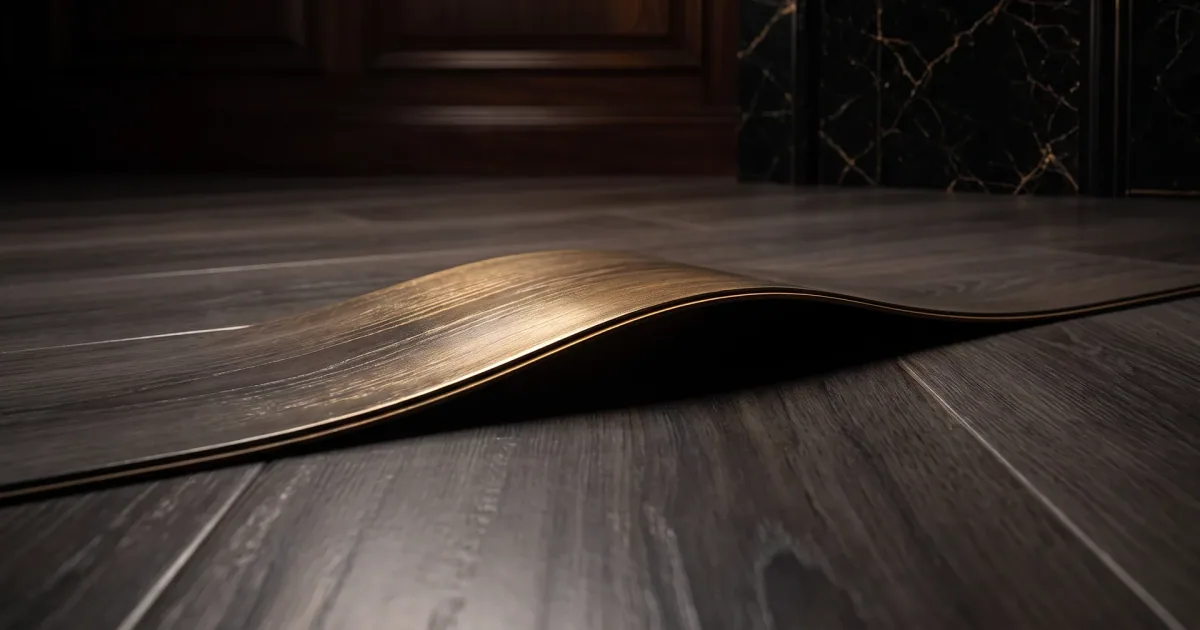
What it looks like

Before and after, in one diagram.

Drag the gold divider, or use the slider underneath. The left side is the fail; the right side is what you are aiming for.

What it sounds like: You step into the middle of the room and the floor clicks, then gives a hollow thump where the plank has lifted off the subfloor.

What went wrong

The plank did not fail. The floor ran out of room. Vinyl expands when it warms up and when it takes on moisture from underneath, and a floating floor needs a gap at every wall, jamb and cabinet to absorb that. Take the gap away and the expansion goes into the weakest joint, which lifts into a ridge and takes the tab with it.

You usually find it barefoot, when the light rakes across the floor: a ridge along a seam, a hollow click underfoot, and often a gap you had not noticed. One joint lost its slack and another was forced open.

The annoying part is that a buckled click plank does not go back. The locking tab is a thin profile of vinyl, and once it stretches it stays stretched. Stand on the ridge for a week and it lies flat while your foot is there, then lifts again when you move. Find the cause before you replace anything.

Why it happened

No room at the edges. A floating vinyl floor needs a gap at every fixed object: skirting, jambs, pipe collars, toe-kicks. Vinyl wants about 1/4 in (6 mm), though the carton wins. Butted to the wall, a warm afternoon has nowhere to push except the nearest seam, the same no expansion gap mistake that leaves laminate peaking at the seams.

Heat. Vinyl softens and expands as it warms. A dark plank in direct sun gets far hotter than the room, and a radiator does the same. A floor with a gap copes; a tight one lifts.

Water underneath. A slab with no vapour barrier, a slow leak, a spill that sat, a wet mop used weekly. Vinyl does not swell like laminate, but water lifts the adhesive on a glue-down floor and cups a plank at the edges. A tide mark is the tell.

Something under the plank. A crumb, a staple, a screw head, a lump of dried adhesive or a high spot. The plank bridges the lump, rocks when stepped on, and the joint above opens. People skip this cause because checking means lifting the plank.

Click and glue-down fail differently. A click floor can sometimes be saved by restoring the perimeter gap and letting it settle. A glue-down floor is stuck, so a lift usually means the adhesive has let go.

When to stop and call someone

Stop if several planks are buckled, if the ridge returns within days of cutting the gap, or if the floor runs under a cabinet or island with no gap. Stop if the subfloor is wet, the slab has no vapour barrier, or planks are lifting in another room. A floor that buckles twice is telling you the cause was missed.

The fix, in order

Do these in this order.

Fixed
  1. Find the high point

    Press the buckle flat-handed, then tap it with a knuckle. Tape the lift's ends; a hollow tap means it is loose.

    10 minutes
  2. Check the perimeter

    Pull the shoe moulding and check the plank ends with a torch. A coin should slide in; vinyl wants 1/4 in (6 mm), but the carton wins.

    20 minutes
  3. Cut the gap

    Run a flush-cut blade flat along the wall to open the gap. Vacuum, then refit the trim unfilled, nailed to the wall and not through the floor.

    45 minutes
  4. Look for moisture

    Press a pin meter into the plank and subfloor. Look for a tide mark; on a slab, tape plastic down overnight.

    15 minutes, plus overnight
  5. Replace the plank

    A buckled click plank has stretched its tab and will not seat. Unzip the run and tap a new plank home with a block.

    1–2 hours

Before you start

Tools and supplies.

Tools

  • Oscillating multi-tool with a flush-cut blade
  • Pull bar
  • Tapping block
  • Rubber mallet
  • Utility knife
  • Pin-type moisture meter
  • Heat gun, for glue-down floors only

Supplies

  • Replacement planks from the same run
  • Spacers
  • Vinyl adhesive, only for glue-down floors
  • Matching baseboard or shoe moulding
  • Painter's tape

Buy the replacement planks before you cut anything. Matching a discontinued run is the hard part, not the labour.

Next time

How to prevent it.

01

Leave a gap at every fixed object

Spacers at walls and jambs until the trim goes on. Vinyl wants 1/4 in (6 mm); the carton wins.

02

Vacuum before the first plank

Sweep, then vacuum. A crumb under a plank is a bump you will feel for years.

03

Watch the afternoon sun

Dark planks in sun get hot enough to expand. A blind beats a re-lay.

The questions people actually ask

Before you start cutting.

Can I flatten a buckled plank with weight?

On a click floor, no: the tab has stretched and the ridge returns when the weight comes off. Heat can help a glue-down plank briefly.

Will cutting the gap fix an existing buckle?

Sometimes, if the lift is recent and the plank has not deformed. Cut the gap, keep traffic off it for a day, and watch.